



When you deliver a brilliant three-month engagement that transforms your client's operations, what happens next? You move on to the next project. Meanwhile, your client struggles to implement everything without you, and the impact fades; six months later, they can't quite remember what made your work so valuable.
So in this article, we’ll show you why project-based consulting isn’t the best strategy for retaining clients and how to switch your consultancy to an outcome-based one.
How Project-Based Consulting Incentivizes the Wrong Behaviors
The project-based model isn't just leaving money on the table; it's actively working against you. Clients don’t just want deliverables anymore.
They want outcomes and proof that your work consistently creates value. Unfortunately, the traditional project model often incentivizes the opposite. Here's what project-based consulting actually rewards:
- Longer projects over faster results: When you bill by the hour or day, efficiency becomes a double-edged sword. That brilliant two-week sprint that solves the core problem? It's worth a fraction of the meandering three-month engagement that includes "change management" and "stakeholder workshops."
- Success is defined by delivery, not impact: In a project-based model, success is measured by whether the project was completed on time and on budget. The incentive is to produce something tangible. A strategy deck, a process map, a roadmap. Whether the client actually uses it? That's their problem. You got paid for the artifact, not the transformation.
- No sustainable value: Your consultants are incentivized to “finish” the work rather than to stay connected and ensure the results stick. This leads to a cycle of one-off engagements and shallow wins, rather than long-term impact. Clients sense it too: they get quick deliverables but limited accountability for sustained results.
- New clients over lasting relationships: The hustle never stops. You're always hunting for the next logo because once a project ends, so does the revenue. There's no reason to stay connected unless you can sell another project.
- Keeping knowledge proprietary: When your value is tied to your time, sharing your frameworks and methodologies too freely feels dangerous. What if clients can just... do it themselves?
What Outcome Partnerships Look Like
Outcome partnerships flip the traditional model on its head. Instead of being paid for outputs, consultants and clients co-own measurable outcomes and work together to achieve them.
So your compensation is tied to whether the needle actually moves, not whether you showed up and looked smart. This approach aligns incentives around impact, not activity.
Consultants can then stay engaged across cycles of strategy, execution, and iteration, building trust and proving value continuously. This sounds terrifying at first. But here's what actually happens when you make this shift:
- You stop optimizing for billable hours and start optimizing for impact: Suddenly, that two-week sprint is valuable again because you can prove it drove a 20% improvement in lead time. You're charging for results.
- Clients become partners, not transactions: When your success is tied to theirs, the relationship fundamentally changes. They're not waiting to catch you padding hours. You're not tiptoeing around the scope. You're both focused on the same thing: moving their metrics.
- Your expertise compounds instead of resets: Every insight you generate for one client becomes a refinement of your methodology. You're not starting from scratch with each engagement. Instead, you're getting better, faster, and more valuable.
- Revenue becomes predictable: Instead of the feast-or-famine cycle of project work, you build a base of recurring partnerships. You know what's coming in next quarter because you're still delivering value to last quarter's clients.
The Infrastructure Gap
But here's where most boutique consultancies hit a wall: outcome partnerships require a completely different operating system than project work.
You can't prove continuous value with monthly status calls and quarterly business reviews. You can't scale your methodology if it lives in your team's heads, and you can't build recurring revenue if clients only interact with you during scheduled meetings.
This is exactly what's keeping larger firms stuck in the old model, and it's the opportunity for boutique consultancies to get ahead of the race.
What you need is Stellafai, and this is how we help.
Stellafai: The Key to Continuous Value Tracking
We built Stellafai specifically for boutique consultancies making this transition. Not as project management software, there's plenty of that, but as the backbone for outcome-driven partnerships. Here’s how;
1. A single source of truth for outcomes
When you start an engagement in Stellafai, you and your client define clear outcomes together. Not vague goals like "improve efficiency," but specific, measurable targets. When you set these up in your Stellafai space, both you and your client can glance at this dashboard and know exactly where things stand.

Overtime, you both can track progress against those outcomes, flag when the momentum is dying and highlight it when breakthroughs happen.
2. Asynchronous value delivery
Your frameworks, your playbooks, your diagnostic tools can become living assets. With the coaching and methodology space in your Stellafai account, you can make these resources available to your clients.
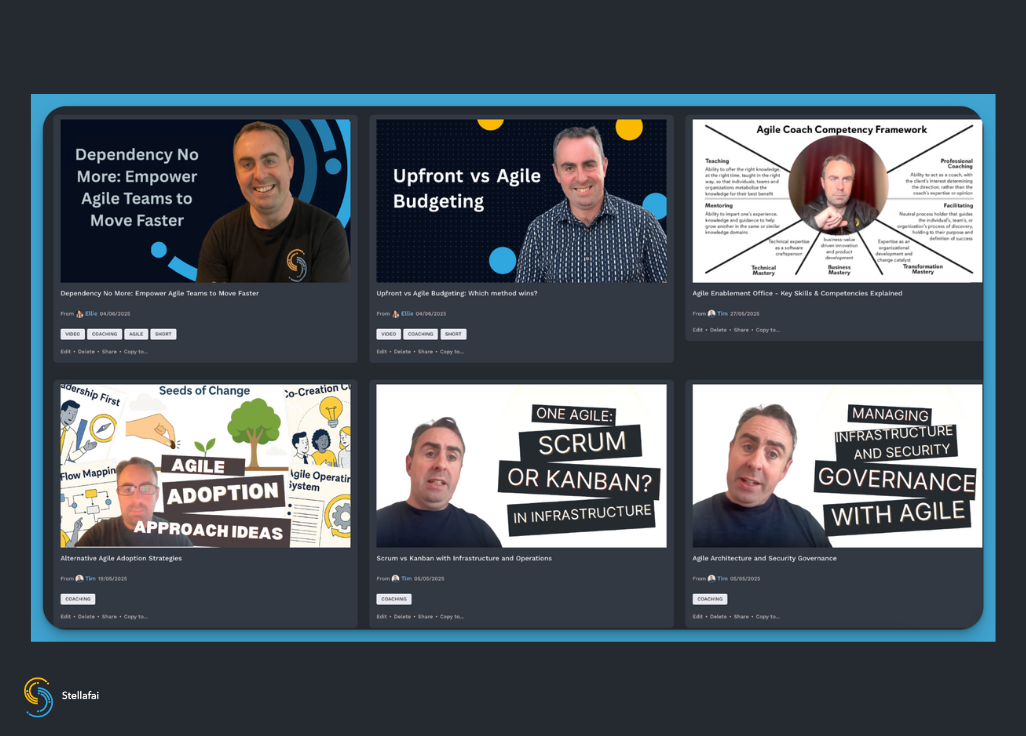
That questionnaire you walk every client through? It's now a digital resource they can revisit. The workshop content that used to disappear after the session? It's now an on-demand library. You're amplifying your reach without diluting your expertise.
3. Automatic documentation of progress
When a client takes action on your recommendation and sees results, it should be captured automatically. Not for your ego for proof of value when renewal conversations happen.
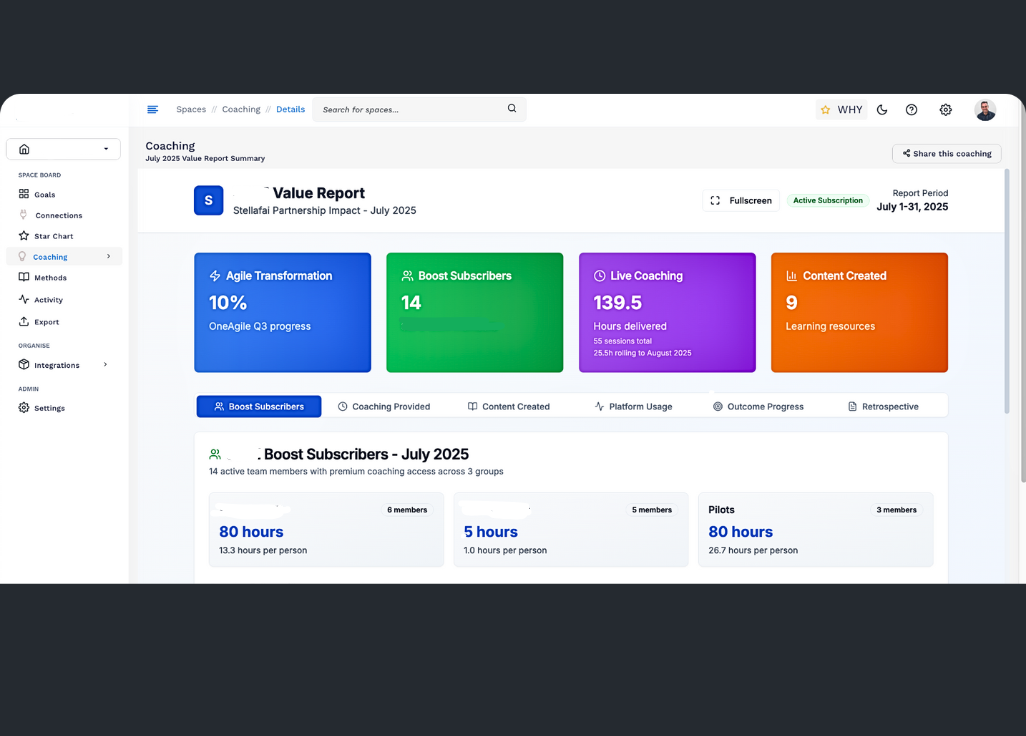
When you set the right key results, Stellafai generates data on your actual impact. Not effort, not activities but impact. When renewal time comes, you're not making a case for why you should continue. You're showing a clear record of measurable value delivered. Month by month, outcome by outcome.
4. Your brand at the center
This isn't about white-labeling someone else's platform. Your methodologies, your frameworks, your point of view all presented as unmistakably yours. Your expertise is front and center. You own the relationship and the intellectual property.
The firms that have built this infrastructure are doing something remarkable: they're generating monthly value summaries that quantify their impact. They're turning one-time workshops into ongoing resources clients reference for months.
They're tracking not just what they recommended, but what clients actually implemented and what results it drove.
Wrapping up
In the next few years, consulting will look radically different. The firms that win won't be the ones with the most impressive credentials or the biggest teams. They'll be the ones that can prove they move the needle.
Ready to see how Stellafai can transform your consulting practice? We've helped dozens of boutique consultancies shift from project-based chaos to outcome-driven partnerships. Book a discovery call and we'll walk you through exactly how this works for firms like yours.

.png)
.png)
.png)